|
Watchdog of the Taxpayer's Dollar Since 1956 Fairfax VA |
|
| Updated July 3, 2008 |
|
|
|
|
On Wednesday, July 9, the Virginia General Assembly will convene a special session to consider both Democrat and Republican-sponsored billion-dollar tax increases for transportation. Call Governor Kaine at (804) 786-2211 and contact your state delegate and senator using the links below. Tell them to fund transportation from existing revenues and not from more tax hikes.
- Identify your state senator and delegate and send them a message
- Voting Information Find your polling place and local, state and federal voting districts.
|
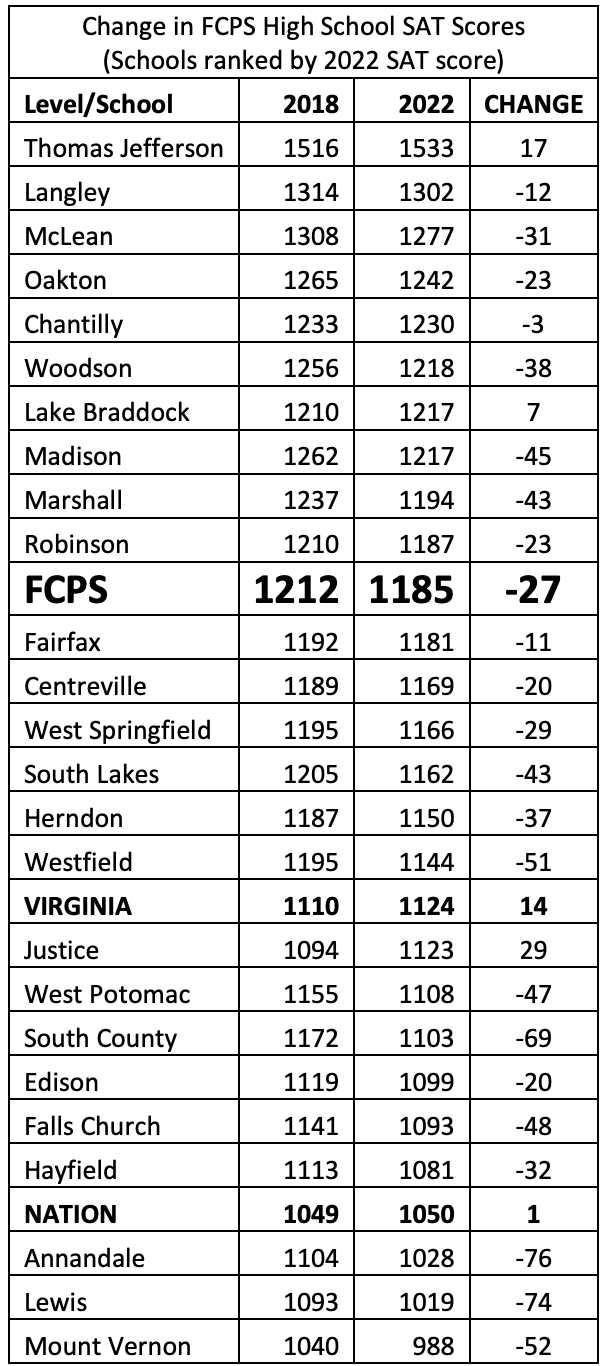
ACT: Thirty-three percent of Fairfax County Public Schools seniors ready for college
|
The Center for Education Reform gives Virginia's charter school law a "D" grade. Virginia has only three charter schools, with a fourth scheduled to open in August, 2008. As of November, 2005, North Carolina had 100 charter schools.
Real estate tax rate 32 cents too high
|
The Connolly Years: Taxes up 10% per year
|
Since 2000, Fairfax County homeowners have experienced record tax increases. In the 19 years preceding 2000, the inflation-adjusted real estate tax for the typical Fairfax County homeowner increased by only $120. However since 2000, the typical homeowner's inflation-adjusted real estate tax increased by $1900. See graph, above.
When inflation is included, Fairfax County residential real estate taxes doubled (see graph) between 2000 and 2007, increasing at an average rate of ten percent per year. During the same period, Fairfax County estimates that taxpayers' household income was increasing two percent per year.
Now, as a result of the transportation bill (HB3202) passed by the General Assembly on April 4, 2007, three more rounds of increased taxes and fees are authorized.
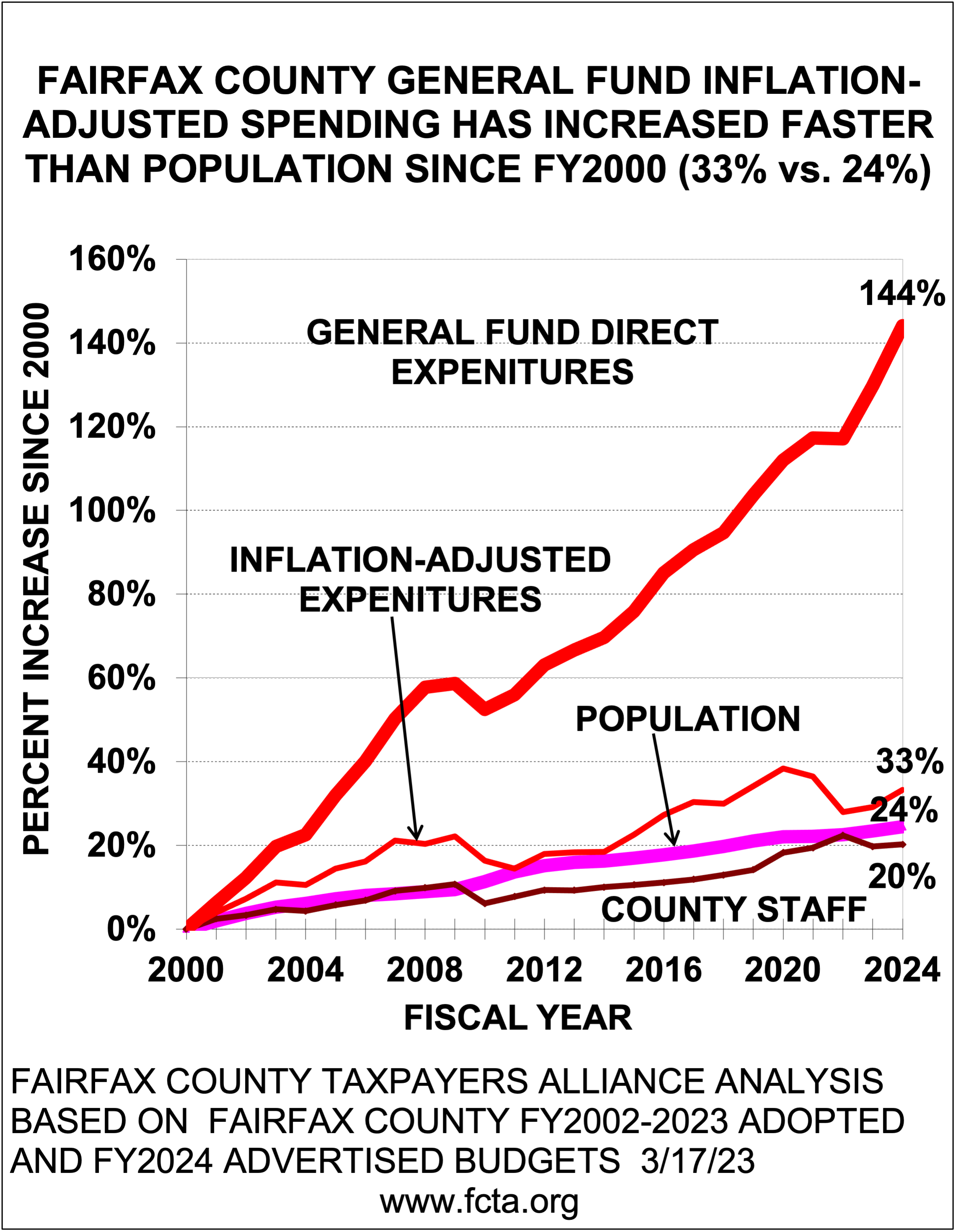
The General Assembly and governor approved these increases even though inflation-adjusted state General Fund revenues (primarily income and sales taxes) have, for decades, been increasing ten times faster than population (see graph).
The first round is a set of statewide increases that became effective on July 1, 2007. These are:
- "Civil Remedial Fees" which are assessed for certain traffic violations (see pdf file). For example the penalty, not including court costs, for failing to give proper signal or driving with an obstructed view or driving 20 MPH or more above the speed limit or driving over 80 MPH will be $1050, payable over 26 months (projected to raise $62 million in FY2009);
- Increased diesel fuel tax, from 16 cents to 17.5 cents per gallon ($21 million in FY2009);
- Increased annual vehicle registration fees. For most Virginians the increase will be from $29.50 to $39.50 ($62 million in FY2009); and
- Increased registration fees for heavy trucks ($27 million in FY2009) and higher fines for overweight trucks ($3 million in FY2009).
FY2009 revenue estimates are from the Northern Virginia Transportation Alliance website.
These new fees and taxes combined with new revenues from the General Fund surplus are expected to provide $500 million in new transportation funding statewide annually.
The second round of new taxes and fees applies to the Northern Virginia and Tidewater regions. These taxes and fees are imposed by regional transportation authorities, the Northern Virginia Transportation Authority (NVTA) and the Hampton Roads Transportation Authority (HRTA). The NVTA voted to impose these taxes and fees, which are estimated to produce $300 million annually, at its meeting on Thursday, July 12, 2007:
- Tax on home sales will increase an additional 40 cents per $100 bringing the total state and local grantor/recordation taxes to 86.66 cents per $100, up from 46.66 cents per $100. This would increase the tax on a $600,000 home from $2,820 to $5,220 ($164 million in FY2009);
- A new initial vehicle registration fee equal to one percent of the value of a vehicle the first time it is registered ($63 million in FY2009);
- A new five-percent tax on auto repairs ($33 million in FY2009);
- A two-percent increase in hotel and motel occupancy taxes, on top of the current two percent to five percent tax ($23 million in FY2009);
- A ten-dollar increase in automobile safety inspections from $15 to $25 ($16 million in FY2009);
- Another ten-dollar increase in annual vehicle registration ($17 million in FY2009). Combined with the statewide increase, the vehicle registration fee for most Northern Virginia residents would increase from $29.50 to $49.50; and
- A two-percent tax on car rentals, from 10 percent to 12 percent.
In the original version of HB3202, each county's board of supervisors had to approve regional tax and fee increases.
However, according to Virginia Governor Kaine's official website, the Governor amended the bill to let the regional transportation authorities to levy the taxes and fees but only after a majority of localities' governing bodies voted to approve the tax and fee increases.
Surprisingly, the final version of HB3202 includes no such requirement for Northern Virginia, although it does include that requirement for Hampton Roads. Compare lines 2520-2525 on page 42 with lines 2472-2487 on page 41 of HB3202 (pdf version - has line numbers) or (HTML version - does not have line numbers).
State Senator Jeannemarie Devolites-Davis, who sponsored the bill in the Virginia senate, told FCTA president Arthur Purves that she expected that the NVTA would not raise the taxes unless the localities had first voted their concurrence.
However, on June 20, the FCTA emailed Fairfax County Chairman Gerry Connolly to ask if Mr. Connolly, a voting member of the NVTA, were going to vote for the tax hike without first asking the Fairfax County Supervisors to vote on it. The FCTA received no answer. The Fairfax County Office of Public Affairs has confirmed, though, that Chairman Connolly has not scheduled either a public hearing or a vote on the regional tax hikes.
The third round of taxes and fees authorized by HB3202 are to be approved by individual counties and cities and could raise $100 million annually:
- Increase commercial real estate taxes up to 25-cents per $100 ($83 million in FY09 based on a rate of 8-cents per $100);
- Local Registration Fee: $10 ($17 million in FY09)
- Commercial/Residential Impact Fee: (to be determined)
The Fairfax County Board of Supervisors will vote on these taxes and fees next year, after supervisor elections in November.
Make a difference. Join the FCTA
(dues: $15 per year) and get a "CUT TAXES" bumper sticker!
We need a large membership to show elected officials and
candidates that there is support for lower taxes.![]()
Download JOIN FCTA
membership flyer! (pdf file)
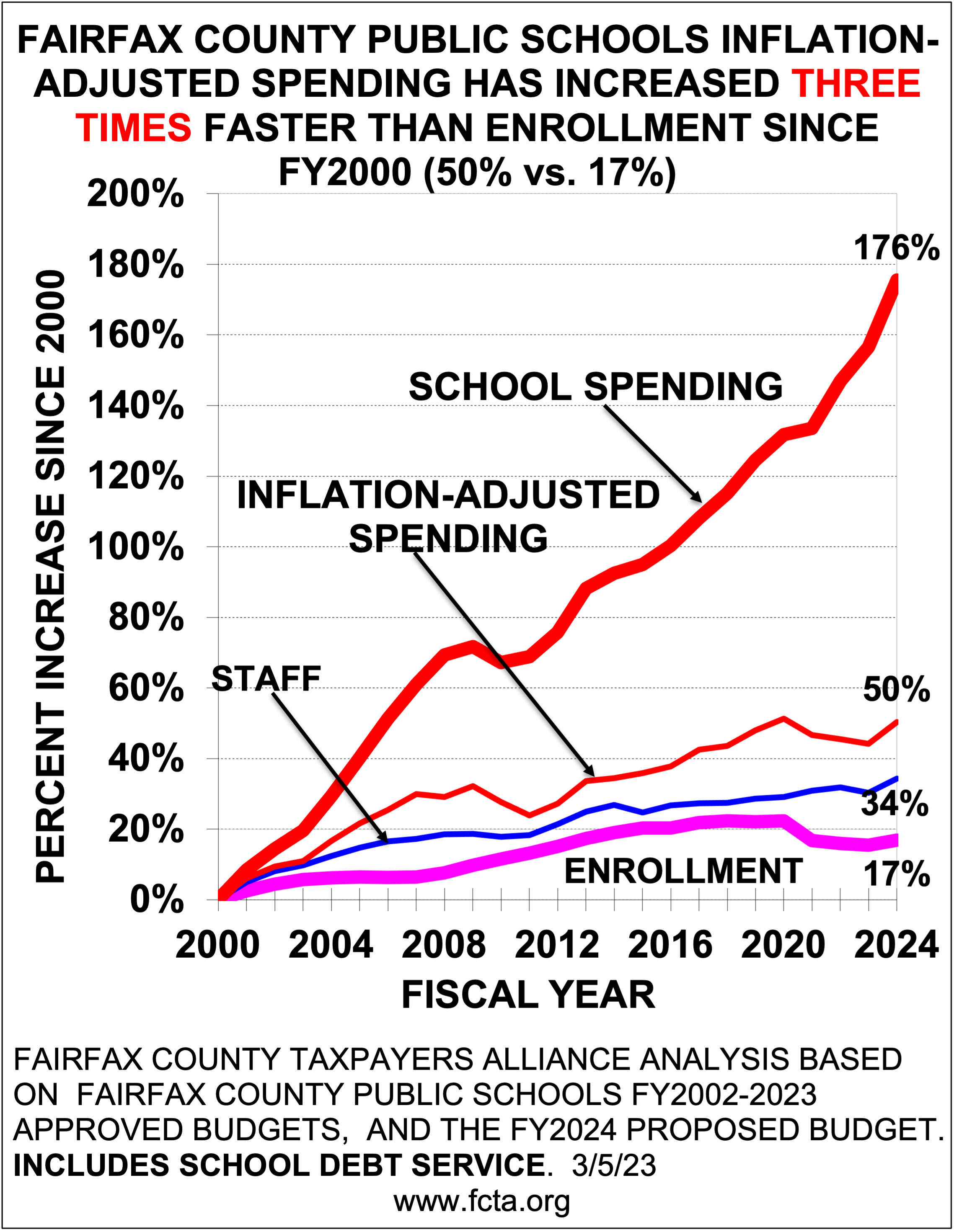
See VEA Petition to Governor Kaine. The phrase "protect future funding for public education and other core services" means "do not spend state income taxes on transportation." Traditionally, transportation has been off-limits from the fast-growing General Fund revenues, which include income taxes, 90 percent of sales taxes, ABC profits, lottery profits, recordation fees, and taxes on insurance premiums. While transportation funding, primarily from gasoline taxes, has languished, school spending, fueled by the General Fund and local taxes, has been increasing ten times faster than enrollment -- even after adjusting for inflation.
The teachers union opposes sharing General Fund revenues with transportation even though, since 2004, General Fund revenues have exceeded projections by nearly $4 billion.
The union does not regard transportation as one of the "core services" of government.
Also, schools have two large funding streams: state government and local government. (Federal funding for local schools is small.) Transportation only has one funding stream, from the state.
Monitor the Virginia Education Association's Daily General Assembly Reports. Note opposition to "raid" on the General Fund (see entries for January 19, 22, 23, 25, ...) and emphasis on staffing ratios instead of student achievement. There is no acknowledgement that inflation-adjusted school spending has been increasing ten times faster than enrollment while transportation funding has trailed population growth (see graphs, below).
Download handout with earlier version of these graphs (1/31/06). This two-page pdf file was given as a handout to the Virginia Senate Finance Committee. It also shows that while staff in Virginia's public schools has been increasing seven times faster than enrollment, Virginia SAT scores have remained flat.
FCTA taxpayer alert, February 10, 2007
See FCTA letter in the February, 2007, edition of the Chronicle Newspapers
See FCTA op-ed in Friday, Feb. 16, 2007, edition of the DC Examiner newspaper:pdf version html version
FCTA testimony before the Fairfax County School Board Public Hearing on the 2008 school budget, January 29, 2007Chairman Storck, Dr. Dale, and members of the board:
Since 2000, real estate taxes for the typical Fairfax County homeowner increased an average of ten percent a year, from about $2400 to $4800. Seventy-five percent of these tax hikes went to Fairfax County Public Schools (FCPS). Inflation-adjusted school spending over that period increased by 35 percent while enrollment increased only six percent. In just two years, school spending on employee benefits is increasing by $100 million. Is it right to raise taxes on the private sector, which is losing benefits, to continue funding public-sector benefits?
Of course it would be right if educational outcomes justified it. Do they? (more ...)
At its meeting on August 15, 2006, the Fairfax County Republican Committee (FCRC) overwhelmingly approved a resolution opposing higher taxes and fees for transportation. The Committee instead urged the Virginia General Assembly to pay for transportation from the budget surplus.The FCRC resolution was drafted by Fairfax County Taxpayers Alliance (FCTA) First Vice-President, the Honorable David C. F. Ray. It was a substitute for an FCTA resolution submitted to the FCRC by FCTA president, Arthur G. Purves.
Resolution Opposing Higher Taxes and Fees for Transportation
Adopted by the Fairfax County Republican Committee, August 15, 2006
- Whereas the Virginia General Assembly during the 2006 session adopted a biennial budget containing record spending increases, and
- Whereas Virginia continues to experience budget surpluses, and
- Whereas the voters of Northern Virginia overwhelmingly rejected the sales tax increase referendum in 2002, and
- Whereas the Virginia General Assembly in 2004 passed the largest tax increase in Virginias history, and
- Whereas the Virginia General Assembly is planning a special session later this year to address transportation, and
- Whereas several interests have proposed various tax increases to fund transportation needs,
Therefore,
- Be it resolved that the Fairfax County Republican Committee calls on the Virginia General Assembly to reject any and all tax and fee increases during the upcoming 2006 special session and the 2007 session, and
- Be it further resolved that the Fairfax County Republican Committee calls on the Virginia General Assembly to use surplus budget money and any as-yet unallocated funds to address transportation needs, and
- Be it further resolved that a copy of this resolution be provided to all Republican members of the General Assembly from Fairfax County prior to the convening of the 2006 special session.
In a Washington Times article Burden of taxes up over 10 years (2/9/06), Virginia Governor Tim Kaine's new Secretary of Finance, Jody M. Wagner, attempts to blame tax increases on the state's car-tax rebate. In fact, former-Governor Gilmore's car-tax rollback accounts for less than ten percent of the state's budget increases over the past ten years. Education and welfare account for 60 percent of the increase.
Slide presentation by Delegate John J. Welch, III. 2006-2008 Commonwealth Budget Proposal(s) (3/15/06 - pdf file) Transportation is underfunded because of the large budget increases for public education and Medicaid. State and local governments employ more workers than any other sector of the national economy Rockefeller Fiscal Studies fast fact State and local government growing faster than general economy Grandfather Economic Report by Michael Hodges (05/13/06) THE NEW NEW LEFT: How American Politics Works Today - Tax Eaters vs. Taxpayers (12/4/05) Real estate taxes fund generous government-sector raises, pensions, and health insurance while the private sector is losing theirs. See FCTA Op-Ed Chichester Wrong on Taxes Chronicle Newspapers (3/31/06)
(2/11/05) This is a large document (23Mb) and takes several minutes to download.FCTA Letter to Editor Assessments not responsible for rising taxes Vienna Times (03/30/06) Download the 2005 Virginia state budget (pdf file - 675 pages, 2.5 Mb) Spends $66B during FY2005 and FY2006. It is House Bill 1500, approved May 4, 2005, and published as Chapter 951, Acts of the Assembly.
Collective Bargaining Drives Away Good Teachers -- Read More Here
Dulles Toll Study Considers $3 Tolls -- Report quietly released eight days before vote to raise tolls
FCTA ARCHIVES
Visit the FCTA Gallery of Government Spending. Fairfax County Government Fairfax County Public Schools Commonweath of Virginia
Updated March 24, 2008
Privacy Policy Contact us at webmaster@fcta.org