Raises and benefit rate hikes for 40,000 county and school employees account for 96 cents of every new tax dollar collected. Not roads. Not school renovations. Not transportation. A structural spending problem that compounds every year.
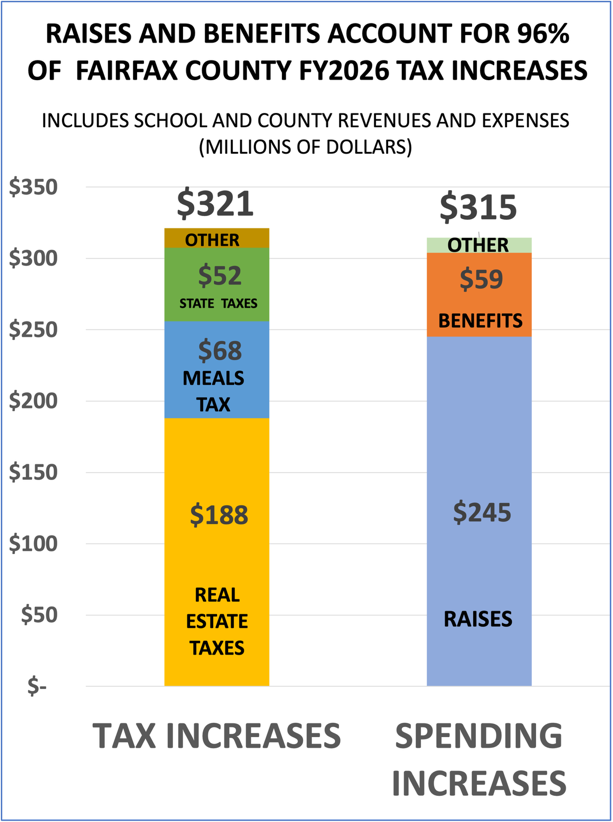
The county and school system collected $321M more in FY2026 than the prior year. Here is what that money paid for:
The revenue side: of $321M in new taxes, $188M came from real estate taxes, $68M from the meals tax, and $52M from state taxes. Nearly every dollar of that went straight to compensation and not to transportation or buildings.
County and school employees receive annual raises — regardless of performance. In the private sector, pay increases are tied to performance and market conditions. In Fairfax County, they are guaranteed. The result is a wage floor that never stops rising.
When Fairfax County raises salaries to match neighboring school districts, those districts respond by raising their own salaries — which then prompts Fairfax to raise again. There is no ceiling to this spiral. Each round is funded by the next tax increase. Taxpayers are trapped financing a competition between government employers that has no finish line.
Most county and school employees can retire with pensions — guaranteed for life and indexed for inflation. The private-sector dropped pensions a generation ago. Pensions (defined-benefit plans) are much more costly than the defined-contribution plans (401k) used in the private sector.
County employee health insurance packages are generous. Every year, insurance rates increase, and taxpayers absorb the difference. This is not a small number when multiplied by 40,000 employees and dependents.
Approximately 50% of all county tax revenue is transferred directly to Fairfax County Public Schools. The overwhelming majority of spending hikes fund employee compensation — not renovations orfacilities maintenance. The school budget has grown dramatically while student outcomes have declined. FCTA's February 2026 bulletin proposes tying school salaries to academic achievement.
Fairfax County subsidizes Metrorail with $100 million annually — a system with fixed routes, aging infrastructure, and reduced ridership. Unlike bus transit, which can adapt routes as population patterns change, rail is a permanently expensive commitment.